Tuesday, May 22, 2012
May 22, 2012 Neither the Fed Nor the ECB Will Be Able to Stop What's Coming
- Gas being at $4 and food prices not far from record highs.
- This being an election year and the Fed now politically toxic.
- Growing public outrage over the Fed's actions (secret loans, etc.) in the past.
Labels: collapse, Crash, credit, Crisis Crash, Debt crisis, Default, Dollar, Euro Collapse, Euro crisis, Euro default


Monday, April 30, 2012
April 30, 2012 The Secrets of the Spanish Banking System That 99% of Analysts Fail to Grasp
Spain is a catastrophe on such a level that few analysts even grasp it.
Indeed, to fully understand just why Spain is such a catastrophe, we need to understand Spain in the context of both the EU and the global financial system.
The headline economic data points for Spain are the following:
- Spain's economy (roughly €1 trillion) is the fourth largest in Europe and the 12th largest in the world.
- Spain sports an official Debt to GDP of 68% and a Federal Deficit between 5.3-5.8% (as we'll soon find out the official number)
- Spain's unemployment is currently 24%: the highest in the industrialized world.
- Unemployment for Spanish youth is 50%+: on par with that of Greece
The answer to these questions lies within the dirty details of Spain's economic "boom" of the 2000s as well as its banking system.
For starters, the Spanish economic boom was a housing bubble fueled by Spain lowering its interest rates in order to enter the EU, not organic economic growth.
Moreover, Spain's wasn't just any old housing bubble; it was a mountain of a property bubble (blue line below) that made the US's (gray line below) look like a small hill in comparison.

In the US during the boom years, it was common to hear of people quitting their day jobs to go into real estate. In Spain the boom was so dramatic that students actually dropped out of school to work in the real estate sector (hence the sky high unemployment rates for Spanish youth).
Spanish students weren't the only ones going into real estate. Between 2000 and 2008, the Spanish population grew from 40 million to 45 million (a whopping 12%) as immigrants flocked to the country to get in on the boom.
In fact, from 1999 to 2007, the Spanish economy accounted for more than ONE THIRD of all employment growth in the EU.
This is Spain, with a population of just 46 million, accounting for OVER ONE THIRD of the employment growth for a region of 490 million people.
This, in of itself, set Spain up for a housing bust/ banking Crisis worse than that which the US faced/continues to face. Indeed, even the headline banking data points for Spain are staggeringly bad:
- Spanish banks just drew €227 billion from the ECB in March: up almost 50% from its February borrowings
- Spanish banks account for 29% of total borrowings from the ECB
- Yields on Spanish ten years are approaching 7%: the tipping point at which Greece and other nations have requested bailouts
Spain's banking system is split into two tiers: the large banks (Santander, BBVA) and the smaller, more territorial cajas.
The caja system dates back to the 19th century. Cajas at that time were meant to be almost akin to village or rural financial centers. As a result of this, the Spanish country is virtually saturated with them: there is approximately one caja branch for every 1,900 people in Spain. In comparison there is one bank branch for every 3,130 people in the US and one bank branch for every 6,200 people in the UK.
Now comes the bad part...
Until recently, the caja banking system was virtually unregulated. Yes, you read that correctly, until about 2010-2011 there were next no regulations for these banks (which account for 50% of all Spanish deposits).
They didn't have to reveal their loan to value ratios, the quality of collateral they took for making loans... or anything for that matter.
As one would expect, during the Spanish property boom, the cajas went nuts lending to property developers. They also found a second rapidly growing group of borrowers in the form of Spanish young adults who took advantage of new low interest rates to start buying property (prior to the housing boom, traditionally Spanish young adults lived with their parents until marriage).
In simple terms, from 2000 to 2007, the cajas were essentially an unregulated banking system that leant out money to anyone who wanted to build or buy property in Spain.
Things only got worse after the Spanish property bubble peaked in 2007. At a time when the larger Spanish banks such as Santander and BBVA read the writing on the wall and began slowing the pace of their mortgage lending, the cajas went "all in" on the housing market, offering loans to pretty much anyone with a pulse.
To give you an idea of how out of control things got in Spain, consider that in 1998, Spanish Mortgage Debt to GDP ratio was just 23% or so. By 2009 it had more than tripled to nearly 70% of GDP. By way of contrast, over the same time period, the US Mortgage Debt to GDP ratio rose from 50% to 90%. Like I wrote before, Spain's property bubble dwarfed the US's in relative terms.
The cajas went so crazy lending money post-2007 that by 2009 they owned 56% of all Spanish mortgages. Put another way, over HALF of the Spanish housing bubble was funded by an unregulated banking system that was lending to anyone with a pulse who could sign a contract.
Indeed, these banks became so garbage laden that a full 20% of their assets were comprised of loan payments being made by property developers. Mind, you, I'm not referring to the loans themselves (the mortgages); I'm referring to loan payments: the money developers were sending in to the banks.
To try and put this into perspective, imagine if Bank of America suddenly announced that 20% of its "assets" were payments being sent in by borrowers to cover mortgage debts. Not Treasuries, not mortgages, not loans... but payments being sent in to the bank on loans and mortgages.
This is the REAL problem with Spain's banking system. It's saturated with subprime and sub-subprime loans that were made during one of the biggest housing bubbles in the last 30 years.
Indeed, to give you an idea of how bad things are with the cajas, consider that in February 2011 the Spanish Government implemented legislation demanding all Spanish banks have equity equal to 8% of their "risk-weighted assets." Those banks that failed to meet this requirement had to either merge with larger banks or face partial nationalization.
The deadline for meeting this capital request was September 2011. Between February 2011 and September 2011, the number of cajas has in Spain has dropped from 45 to 17.
Put another way, over 60% of cajas could not meet the capital requirements of having equity equal to just 8% of their risk-weighted assets. As a result, 28 toxic caja balance sheets have been merged with other (likely equally troubled) banks or have been shifted onto the public's balance sheet via partial nationalization.
On that note, I fully believe the EU in its current form is in its final chapters. Whether it's through Spain imploding or Germany ultimately pulling out of the Euro, we've now reached the point of no return: the problems facing the EU (Spain and Italy) are too large to be bailed out. There simply aren't any funds or entities large enough to handle these issues.
Labels: collapse, Crash, credit, Crisis Crash, Default, depression, Euro default, Euro finished, Spain
Monday, April 23, 2012
Here Comes Spain, be aware!
As expected Francois Hollande won the first round of the French elections. He and Nicolas Sarkozy will run against each other in the second round, which will occur on May 6th.
The Euro isn't taking this news well. As I write this Sunday night the Euro currency futures have gapped down. I've added this move to the chart below.
130 remains the line in the sand for the Euro. If we take it out with conviction then we're in BIG trouble.
I believe we're at most a month or so away from this. Spain has now stepped center stage in the Euro Crisis. And the Spanish Ibex has just taken out its 15-year trendline:
This spells MAJOR trouble for Spain and the rest of the EU. Unlike Greece, (which has its own elections, which could go very wrong for the EU, on May 6th by the way), Spain is too big to bail out. Indeed, the Spanish banking system is a toxic sewer of bad mortgage debt: over half of all mortgages were generated and owned by the unregulated cajas. If you're unfamiliar with the caja banking system, let me give you a little background...
Until recently, the caja banking system was virtually unregulated. Yes, you read that correctly, until about 2010-2011 there were next no regulations for these banks (which account for 50% of all Spanish deposits). They didn't have to reveal their loan to value ratios, the quality of collateral they took for making loans... or anything for that matter.
As one would expect, the cajas have been collapsing like dominos in the last few years. Spain's been trying to prop them up by merging them with larger (likely equally insolvent) banks with no success (the merged banks have all collapsed to new lows in the last month).
On top of this, Spanish Banks are drawing a record €316.3 billion from the ECB (up from €169.2 billion in February).
Things have gotten so bad that Spanish citizens are pulling their money out of Spain en masse: €65 billion left the Spanish banking system in March 2011 alone. And all of this is happening at a time in which relations are breaking down between Germany and the ECB as well as between Germany and France.
In other words, the EU collapse is about to enter its next round. Remember, all collapses follow the same pattern:
2) the re-test/ attempt to reclaim upwards momentum
3) the roll-over/ REAL fireworks
So if you're not already taking steps to prepare for the coming collapse, you need to do so now.
Labels: collapse, Crash, crisis, Default, Euro crisis, Spain
Monday, March 26, 2012
A Tenuous Balance is in Place
The markets will likely try to rally this week based on the following items:
1) End of quarter performance gaming
2) Last week's weak stock performance
3) Angela Merkel signaling that Germany will increase the pointless "firewall" around Europe's banking system
4) Bernanke's hint that more QE is coming in April in this morning's speech
#1 is a regular phenomenon in the markets and needs not be explained. #2 is closely tied in with the latest policy of verbal intervention on the part of the Fed: any time stocks weaken some Fed official, usually Charles Evans of Chicago or Bill Dudley of New York, gives a speech suggesting more easing is just around the corner and VOOM! stocks take off again.
#3 is just the next step in Germany trying to hold the EU together long enough to see how the French elections turn out in April/ May. Given that Merkel's political ratings drop like a stone any time she spends more German money and explode higher any time she plays hardball with the EU, we can take this move to be mainly posturing and playing for time.
Indeed, France is now a wildcard in the great EU bailout scheme. Most polls show a socialist winning in the second round of the elections. And not just any socialist, but François Hollande.
A few facts about Hollande:
1) He just proposed raising tax rates on high-income earners from 41% to 75%.
2) He wants to lower the retirement age to 60.
3) He completely goes against the recent new EU fiscal requirements Merkel just convinced 17 EU members to agree to and has promised to try and renegotiate them to be looser.
So Merkel knows that if Hollande wins in France, her campaign to turn the EU into a fiscally responsible German-led group of colonies will be over. Europe could very well collapse before then as the Spanish and Italian bond markets are flashing danger signs again (despite the world believing LTRO's 1 and 2 solved everything). And the facts remain that the entire EU banking system is a disaster waiting to hit (anyone notice that EU banks continue to park cash at the ECB like there's a systemic catastrophe looming?)
Finally, Bailout Ben Bernanke just hinted at more QE in his speech at the National Association for Business Economics this morning. With gas prices at $4 and food prices not far off from their all time highs, I cannot see how Bernanke can possibly unveil more QE without unleashing major political outrage and destroying Obama's chances at re-election (Obama did re-elect Bernanke as Fed Chairman).
So I view this hint as more posturing from Bernanke. He likely is aware that seasonal adjustments have made all economic data from the last three months look better than reality and is simply trying to prep the markets for what's likely going to be a slew of bad data started in 2Q12. We also have to note that stocks took it on the chin last week, so Bernanke could very well be maintaining item #1 on the list above: verbally intervening to keep the markets up.
Big picture: the markets are being held together via a very tenuous balancing act on the part of EU leaders and the world Central Banks. The short-term bias will be bullish due to the factors listed above. But big trouble is lurking just beneath the surface. And should anything upset the current balance being maintained, we could see some real fireworks in the markets in short order.
Labels: collapse, Default, disaster, Euro Collapse, Euro crisis, France crisis
Thursday, February 02, 2012
Why Notions of Systemic Failure Are On Par with Bigfoot and Unicorns for Most Investors
I wanted to take a moment to address the notion of serious collapse and/or systemic failure and why it's so hard for most investors to conceive.
First off, most people in general tend to be optimists or to generally believe that things will work out fine. So the idea of catastrophe is not something they spend much time thinking about.
Because of this, and other factors I'm about to explore, the notion of systemic failure is virtually impossible to grasp for most investors. Most professional traders are usually under the age of 40 (in fact they're typically in their mid to late 20s). As a result of this, they:
1) Didn't experience the 1987 Crash
2) Have never seen a Crisis that the Fed/ IMF/ etc. couldn't handle
Let's add a secondary element to this. Most institutional traders today operate, for the most part, based on trading models. These models, in general, are quantitative and based on correlations and patterns, not qualitative judgments.
This goes a long ways towards explaining why the market has developed such simplistic trading patterns. Consider the "Monday market rally" phenomenon we saw throughout 2009-2010. Or how about the Aussie Dollar/Japanese yen correlation to the S&P 500 we saw throughout much of 2010-2011. As one asset manager put it to me recently, the market has essentially become "one big trade" with virtually all asset classes moving tick for tick relative to each other.
Let us consider the mentality these age demographics and professional working tools engender. In general, both of these factors make for short-term thinking and a lack of qualitative analysis. They also mean that items or developments that exist outside the universe of trading models (most of which are entirely based on post-WWII data), are outside the scope of these traders' thinking.
This issue doesn't merely pertain to traders either. Going back 80+ years, there's never been a time in which the markets didn't have a backstop in the form of the Fed/ IMF/ or some other entity. No matter the Crisis that erupted, there was always money printing and other monetary policies to calm the storm.
Now, let's expand our analysis outside of professional traders to include asset managers and other institutional investors, the vast majority of whom are under the age of 60 or so.
Based on this age demographic, we find that there is an entire generation of investment professionals (aged 35-60) who:
- Have never witnessed nor invested during a bear market in bonds
- Have never witnessed, nor invested during a credit market collapse
- Have never witnessed a secular shift in the global economy
Consequently, the vast majority of professional investors are unable to contemplate truly dark times for the markets. After all, the two worst items most of them have witnessed (the Tech Bust and 2008) were both remedied within about 18 months and were followed by massive market rallies.
Because of this, the idea that the financial system might fail or that we might see any number of major catastrophes (Germany leaving the EU, a US debt default, hyperinflation, etc.) is on par with Bigfoot or Unicorns for 99% of those whose jobs are to manage investors' money or advise investors on how to allocate their capital.
If this doesn't worry you, you need to start looking at the actual numbers behind the financial system today. Here are just a few worth considering:
- US commercial banks currently sit atop $248 TRILLION in derivatives
- The US Federal Reserve is now buying 91% of all long-term new US debt issuance (at the same time China and Russia are dumping US bonds)
- Japan already spends roughly half of its annual tax revenues on debt payments and has relied on debt issuance more than tax revenues to fund its budget for four years now (how much longer can this last?)
- Europe's entire banking system is leveraged at 26 to 1 (Lehman Brothers was leveraged at 30 to 1 when it failed)
!
Folks, bad times are coming. It doesn't matter what the trading programs or "professionals" think about it... the math simply doesn't add up to us having a calm, profitable time in the markets over the next few years.
Labels: collapse, Crash, crisis, Default
Monday, December 19, 2011
Deflation
Here's the 30-Year Treasury Bond:

As you can see, we've already surpassed the former all-time established during the nadir of the 2008-2009 Crisis. To say this is deflationary would be an understatement. Indeed, on the shorter end of the bond curve Treasuries are yielding 0% (the 3-month), 0.02% (the six month) and 0.2% (the two year).
Put another way, investors are essentially willing to lend to the US for almost NOTHING in return for up to two years... based solely on the notion that by doing so they're at least "guaranteed" a return OF capital.
DE-flation.
Here's Gold:
Considering that Gold is a leading indicator for stocks... and that the precious metal only breaks below its long-term uptrend in times of systemic risk, the above breakdown is a MAJOR red flag that something BAD is brewing in the financial system. That something is another round of DE-flation.
How about Agricultural commodities... which anticipated QE Lite and QE 2 before every other asset class?
As you can see, we've wiped out ALL of the QE 2 gains and are now on the verge of breaking back into a trading range that goes back to 2009. Again, DE-flation.
And then there's stocks... the most clueless of asset classes, which simply don't "get it"... yet.
As you can see, while Europe's banking system is imploding, Gold has broken its long-term uptrend, and US Treasuries are signaling a Crisis even worse than 2008, stocks are bouncing off of support as though there's no real danger.
This can be attributed to three factors:
1) Light volume (fewer and fewer folks are investing in stocks which allows Wall Street to move the market more easily).
2) End of the year performance gaming by hedge funds and institutions (most of which have had horrible years)
3) Misguided hope and delusions... just like the ones we had in 2008 when stocks didn't "get it" until the whole system was ready to collapse
In simple terms, the best analysis of today's markets is that we are getting MAJOR red flags across the board that another round of DE-flation is here.
Against this backdrop, stocks are as clueless as they were in 2008. And given that most traders will be taking off early this week, those remaining will be able to move the market any way they please as volume will be even lower than the abysmal levels we've seen for most of 2011.
So my advice is to avoid trading this week if you can help it. There is simply too much uncertainty in the market: stocks could rally based on end of the year shenanigans... or they could just as easily collapse due to Europe or any number of other issues in the system today.
However, the larger picture indicates that deflation is back and it's back with a vengeance. It would be wise to prepare in advance for this as stocks are ALWAYS the last to "get it." And by the looks of the recent action in Gold and Treasuries, "It" is going to be something VERY unpleasant.
Labels: collapse, Crash, Debt crisis, Deflation
Monday, December 05, 2011
Europes Banks ARE insolvent
Equities got giddy last week when the world's central banks, lead by the US Federal Reserve, lowered the global cost of borrowing Dollars. Regardless of the market's reaction, the whole thing smells of desperation and quite frankly, everyone should be questioning the Fed's move.
First of all, the situation in Europe is a solvency Crisis, not a liquidity Crisis. European banks need over one trillion Euros in new capital. Providing more cheap credit is not going to do anything other than give those European banks which are facing liquidity troubles a few more weeks life support.
Speaking of which, it's now clear that Europe is fast approaching its Lehman moment. Forbes noted that a large European bank was on the ropes the night before the Fed intervention. We also see France and Germany are implementing plans to nationalize large banks that fail. I can assure you they're not doing this because things are going well over there.
As for the market's reaction to the Fed's move... it could kick off a short-term end of the year rally depending on how much the market falls for the "this time we've got a REAL solution" tripe coming our of Europe. But, you must remember that none of the proposed solutions address the underlying problems Europe's banks are facing.
Technically, the Fed's move brought the market to major resistance. Unless the market moves higher aggressively to start this week, we're heading back down in short order.
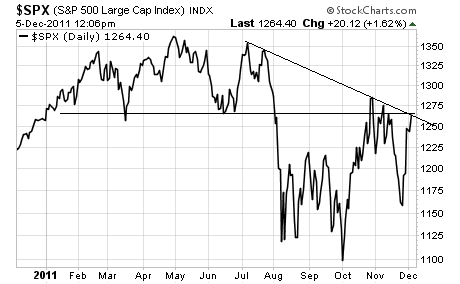
Truly, the only reason to buy into a stock rally here is based on the belief that the Fed or someone else is going to be providing more juice in the near future. The US economy has clearly begun to roll over in a big way: retail sales, GDP, and unemployment numbers are all being massaged heavily to make the situation look better than it is.
This is clear in corporate earnings which just posted their worst sequential drop since the first quarter of 2009: when the economy and markets were both falling off a cliff. These kinds of drops don't happen if everything's going well.
Across the pond, Europe's banking system is experiencing a solvency crisis on par with 2008. The markets believe that Germany and France will save the day by re-vamping the EU arrangement. However, this doesn't mean other EU members will agree to their suggestions (the idea of a German-lead EU is completely unpalatable to many EU states).
So I don't expect a viable solution to emerge in Europe this week. The math doesn't support any of the proposals EU leaders have come up with yet. And the fact it was the Fed, NOT the IMF or ECB or EFSF that stepped in to save the day last week should be a major red flag that Europe's out of ideas.
The markets seem to sense this as the Euro hasn't cleared resistance in any meaningful way yet. And unless we get above 135 and stay there, we're heading a LOT lower in the near future.
To conclude, in the short-term the markets are moving based on hope of more juice from the Powers That Be. However, the reality of the financial system today is downright frightening. The US economy is rolling over in a big way. Europe is imploding. China is heading straight into a hard landing. And on and on.
Heck, Europe alone could derail the entire financial system temporarily. The region's entire banking system is insolvent (with few exceptions). European non-financial corporations are running massive debt to equity ratios. And even EU sovereign states require intervention from the ECB just to meet current debt issuance, to say nothing of the huge amount of sovereign debt roll over that is due over the next 14 months.
The impact of this will be global in nature. The EU, taken as a whole, is:
1) The single largest economy in the world ($16.28 trillion)
2) Is China's largest trade partner
3) Accounts for 21% of US exports
4) Accounts for $121 billion worth of exports for South America
So if the EU banking system/ economy collapses, the global economy could enter a recession just based on that one issue alone (ignoring the other issues in China, Japan, and the US).
This is the reality of the financial system, no matter what the talking heads say. The IMF, Bank of England, and others have warned of a systemic collapse... do you think they're doing this for fun?
Many investors will have their portfolios wiped out in the coming carnage. It could be next week, or it could take place next year... but we ARE heading into a Crisis that will be worse than 2008.
Labels: collapse, Crash, Euro crisis, Euro default, europe