Tuesday, May 22, 2012
May 22, 2012 Neither the Fed Nor the ECB Will Be Able to Stop What's Coming
- Gas being at $4 and food prices not far from record highs.
- This being an election year and the Fed now politically toxic.
- Growing public outrage over the Fed's actions (secret loans, etc.) in the past.
Labels: collapse, Crash, credit, Crisis Crash, Debt crisis, Default, Dollar, Euro Collapse, Euro crisis, Euro default


Monday, April 23, 2012
Here Comes Spain, be aware!
As expected Francois Hollande won the first round of the French elections. He and Nicolas Sarkozy will run against each other in the second round, which will occur on May 6th.
The Euro isn't taking this news well. As I write this Sunday night the Euro currency futures have gapped down. I've added this move to the chart below.
130 remains the line in the sand for the Euro. If we take it out with conviction then we're in BIG trouble.
I believe we're at most a month or so away from this. Spain has now stepped center stage in the Euro Crisis. And the Spanish Ibex has just taken out its 15-year trendline:
This spells MAJOR trouble for Spain and the rest of the EU. Unlike Greece, (which has its own elections, which could go very wrong for the EU, on May 6th by the way), Spain is too big to bail out. Indeed, the Spanish banking system is a toxic sewer of bad mortgage debt: over half of all mortgages were generated and owned by the unregulated cajas. If you're unfamiliar with the caja banking system, let me give you a little background...
Until recently, the caja banking system was virtually unregulated. Yes, you read that correctly, until about 2010-2011 there were next no regulations for these banks (which account for 50% of all Spanish deposits). They didn't have to reveal their loan to value ratios, the quality of collateral they took for making loans... or anything for that matter.
As one would expect, the cajas have been collapsing like dominos in the last few years. Spain's been trying to prop them up by merging them with larger (likely equally insolvent) banks with no success (the merged banks have all collapsed to new lows in the last month).
On top of this, Spanish Banks are drawing a record €316.3 billion from the ECB (up from €169.2 billion in February).
Things have gotten so bad that Spanish citizens are pulling their money out of Spain en masse: €65 billion left the Spanish banking system in March 2011 alone. And all of this is happening at a time in which relations are breaking down between Germany and the ECB as well as between Germany and France.
In other words, the EU collapse is about to enter its next round. Remember, all collapses follow the same pattern:
2) the re-test/ attempt to reclaim upwards momentum
3) the roll-over/ REAL fireworks
So if you're not already taking steps to prepare for the coming collapse, you need to do so now.
Labels: collapse, Crash, crisis, Default, Euro crisis, Spain
Monday, March 26, 2012
A Tenuous Balance is in Place
The markets will likely try to rally this week based on the following items:
1) End of quarter performance gaming
2) Last week's weak stock performance
3) Angela Merkel signaling that Germany will increase the pointless "firewall" around Europe's banking system
4) Bernanke's hint that more QE is coming in April in this morning's speech
#1 is a regular phenomenon in the markets and needs not be explained. #2 is closely tied in with the latest policy of verbal intervention on the part of the Fed: any time stocks weaken some Fed official, usually Charles Evans of Chicago or Bill Dudley of New York, gives a speech suggesting more easing is just around the corner and VOOM! stocks take off again.
#3 is just the next step in Germany trying to hold the EU together long enough to see how the French elections turn out in April/ May. Given that Merkel's political ratings drop like a stone any time she spends more German money and explode higher any time she plays hardball with the EU, we can take this move to be mainly posturing and playing for time.
Indeed, France is now a wildcard in the great EU bailout scheme. Most polls show a socialist winning in the second round of the elections. And not just any socialist, but François Hollande.
A few facts about Hollande:
1) He just proposed raising tax rates on high-income earners from 41% to 75%.
2) He wants to lower the retirement age to 60.
3) He completely goes against the recent new EU fiscal requirements Merkel just convinced 17 EU members to agree to and has promised to try and renegotiate them to be looser.
So Merkel knows that if Hollande wins in France, her campaign to turn the EU into a fiscally responsible German-led group of colonies will be over. Europe could very well collapse before then as the Spanish and Italian bond markets are flashing danger signs again (despite the world believing LTRO's 1 and 2 solved everything). And the facts remain that the entire EU banking system is a disaster waiting to hit (anyone notice that EU banks continue to park cash at the ECB like there's a systemic catastrophe looming?)
Finally, Bailout Ben Bernanke just hinted at more QE in his speech at the National Association for Business Economics this morning. With gas prices at $4 and food prices not far off from their all time highs, I cannot see how Bernanke can possibly unveil more QE without unleashing major political outrage and destroying Obama's chances at re-election (Obama did re-elect Bernanke as Fed Chairman).
So I view this hint as more posturing from Bernanke. He likely is aware that seasonal adjustments have made all economic data from the last three months look better than reality and is simply trying to prep the markets for what's likely going to be a slew of bad data started in 2Q12. We also have to note that stocks took it on the chin last week, so Bernanke could very well be maintaining item #1 on the list above: verbally intervening to keep the markets up.
Big picture: the markets are being held together via a very tenuous balancing act on the part of EU leaders and the world Central Banks. The short-term bias will be bullish due to the factors listed above. But big trouble is lurking just beneath the surface. And should anything upset the current balance being maintained, we could see some real fireworks in the markets in short order.
Labels: collapse, Default, disaster, Euro Collapse, Euro crisis, France crisis
Thursday, February 16, 2012
Greece is Not Lehman 2.0... As I'll Show You, It's Far Far Worse...
Investors simply do not understand the significance of Greece. Comparisons are being made to Lehman, but these comparisons are moot for the following reason: Greece is a country not a private institution.
This is not a subtle difference. True, Lehman's derivatives were spread throughout the global financial system just as Greek sovereign debt is. However, investors are missing the true scope of the fall-out a Greek default would create.
First, let's think about Lehman. When Lehman went under, half of the other institutions that were in trouble had already been merged with larger entities (Bear Stearns, Merrill Lynch) or had been nationalized (Fannie and Freddie). Those that were still standing after Lehman went under, changed to bank holding companies (Morgan Stanley, Goldman Sachs) in order to receive special access to Fed lending or were nationalized (AIG).
None of these options exist regarding the sovereign crisis in Europe today. If Greece defaults, Portugal can't merge with Spain. And Italy can't be nationalized by Germany or suddenly change itself to a new type of country that gets special treatment from the ECB (it's already getting special treatment from the ECB by the way).
This cuts to the core issues for sovereign defaults in the EU. Here are the facts regarding those EU countries on the verge of collapse:
1) You cannot solve a debt problem with more debt
2) Austerity measures slow economic growth which in turn makes it harder to meet debt payments
This is simple basic common sense. But these are the policies being promoted by EU leaders: we'll give you more money if you implement more austerity measures to get your finances in order. (Stupidity!)
The fact of the matter is that there is simply no way on earth that Greece can get its finances in order (short of a massive default). Greece has terrible age demographics, a lack of economic growth, and cultural issues (e.g. paying taxes is for suckers) that make it impossible for the country to solve its financial problems.
In plain terms, Greece racked up too big of a tab and simply doesn't have the means of paying it. End of story. The world needs to realize this. Because Greece will default and it will default in a big way!!!
The impact of this will be tremendous. For one thing, pretty much everyone is lying about their exposure to Greece. Consider Germany for instance. According to the Bank of International Settlements German bank exposure to Greece is only $3.9 billion (though they state this is only on an immediate borrower basis).
This is a bit odd as according to The Guardian German banks have nearly 8 billion Euros' worth of exposure to Greek debt. And they only include 11 German banks in their analysis. However, of those 11 banks, THREE of them have Greek exposure equal to more than 10% of their total outstanding equity.
But even these numbers are far below the mark. By my own analysis one of the "strongest" banks in Germany alone, by its own admission, has twice the exposure to Greece that the Guardian claims. And this is one of the strongest banks in Germany.
So, when Greece defaults, the fall-out will be much, much larger than people expect simply by virtue of the fact that everyone is lying about their exposure to Greece.
Secondly, when Greece defaults, the other PIIGS (Italy, Ireland, Spain, and Portugal) will have to ask themselves... "do we opt for austerity measures and more debt which obviously didn't work for Greece and will only stifle our economies more? Or do we also default?"
That's a very tough question to answer. But I'd wager more than one of them will opt for default. And if you think European bank exposure to Greece is understated, you don't even want to know how bad exposure to Italy and Spain is (to give you an idea, the German bank I referred to earlier, again by its own admission, has total PIIGS exposure equal to 60% of its equity)!
Folks, the European banking system is literally on the edge of the abyss. This won't be Lehman 2.0. This is going to be something far, far worse. Some of these countries are already sporting unemployment of 20%. What happens when their largest banks go under?
Also, remember that the EU is:
1) The single largest economy in the world ($16.28 trillion)
2) China's largest trade partner
3) Accounts for 21% of US exports
4) Accounts for $121 billion worth of exports for South America
The global impact of an EU banking Crisis will be tremendous. And it's clear the EU is already heading into a recession without a banking crisis hitting. What do you think will be the impact when Europe as a whole experiences its own "2008" only on a sovereign level?
The answer is: we are literally on the eve of a Crisis that will make 2008 look like a picnic.
On that note, if you have not already taken steps to prepare for the next round of the Crisis now is the time to do so while the system is still holding together.
Labels: Collaps, Crash, crisis, Default, Euro Collapse, Euro crisis
Wednesday, January 18, 2012
Germany's Fed Up and Getting Ready to Walk
The reasons for this are simple:
1) The German public and court system won't stand for QE from the European Central Bank
2) Issuing Euro bonds goes against the German constitution
3) Germany has its own share of domestic problems with a REAL Debt to GDP ratio north of 200% and its banks needing tens of billions of Euros in new capital
All of these factors lead me to believe that Germany would refuse to be the ultimate backstop for the EU. You could also see Germany preparing the legislation to allow it to walk if it wanted to:
German Chancellor Angela Merkel's Christian Democratic Union party voted to allow euro states to quit the currency area, endorsing the prospect of a move not permitted under euro rules.
The resolution reads:
"Should a member [of the euro zone] be unable or unwilling to permanently obey the rules connected to the common currency he will be able to voluntarily--according to the rules of the Lisbon Treaty for leaving the European Union--leave the euro zone without leaving the European Union. He would receive the same status as those member states that do not have the euro."
I believe Germany implemented this legislation for itself... not some other country. And by the look of things, Germany's getting a lot closer to walking.
BBK Thiele: Current ECB Government Bond Buys Violate Treaty
The European Central Bank's government bond buys are a violation of the Maastricht Treaty, Bundesbank board member Carl-Ludwig Thiele said Monday.
Thiele's comments depart form the official Bundesbank line. While the German central bank has warned that larger purchases may be illegal, it has said that current purchases do not violate the prohibition of monetary financing.
Thiele recalled that the decision to buy Greek government bonds had found no support from German ECB Governing Council members. "Germany was over-ruled on the Council," Thiele said.
"These buys were a violation against the prohibition of monetary financing, that is the basic principle that a central bank should not give credit to a state," Thiele said in a speech text provided by the Bundesbank.
Bundesbanker says euro zone must forget idea of QE
Europe must abandon the idea that printing money, or quantitative easing, can be used to address the euro zone debt crisis, Bundesbank board member Carl-Ludwig Thiele said on Monday.
Thiele called for euro zone countries to exercise fiscal discipline and said that boosting the resources of Europe's rescue funds would buy time to address the bloc's debt woes.
"But lasting confidence cannot be bought with money alone," he added in the text of a speech for delivery in Hamburg.
"One idea should be brushed aside once and for all - namely the idea of printing the required money. Because that would threaten the most important foundation for a stable currency: the independence of a price stability orientated central bank."
These are extremely strong statements coming from the Bundesbank. Remember, Merkel is the German political leader, but she doesn't control the purse strings to Germany: the German courts and Bundesbank do. And if they don't support more bailouts, there's nothing Merkel can do.
We see similar warnings coming out of German CEOs:
Linde CEO says Germany should mull euro exit-paper
Germany should consider leaving the euro if efforts to impose fiscal discipline upon indebted euro zone countries fail, the head of industrial gases firm Linde (LING.DE) told German weekly paper Der Spiegel.
"I fear the willingness of crisis countries to reform themselves is abating if, in the end, the European Central Bank steps in," Linde's chief executive Wolfgang Reitzle was quoted as saying.
"If we do not succeed in disciplining crisis countries, Germany needs to exit," said Reitzle who was previously a board member at carmaker BMW (BMWG.DE) and head of Jaguar and Land Rover.
http://in.reuters.com/article/
I firmly believe Germany is already makings moves to prepare for precisely this outcome. No EU member state is going to submit to German authority regarding fiscal policies. Indeed, virtually every EU legislation passed in the post-WWII era was aimed at limiting Germany's power.
And Germany isn't going to simply prop up the EU out of the goodness of its heart. As I mentioned before, Germany has its own domestic issues to deal with. And when push comes to shove, Germany will look after its own interests rather than Greece's or Italy's.
With that in mind I believe it's only a matter of time before Germany walks out of the EU. When this happens the Euro will collapse a minimum of 20-30% and we will see numerous sovereign defaults.
When the smoke clears the EU in its current form will be broken and we will have passed through a Crisis far worse than 2008.
Many people see their portfolios go up in smoke with this. Don't be one of them. The time to prepare your portfolio for the collapse is NOW before it starts.
Labels: Crash, Default, Euro Collapse, Euro crisis
Wednesday, December 21, 2011
We've Reached the End Game for Central Bank Intervention.
In 2008, the Central Banks, lead by the US Federal Reserve, decided not to "take the hit." They've since spent trillions of Dollars propping up the financial system. By doing this, they've essentially attempted to fight a debt problem by issuing more debt.
The end result is similar to what happens when you try to cure a heroine addict by giving him more heroine: each new "hit" has less and less effect.
Case in point, consider the Central Banks' coordinated intervention to lower the cost of borrowing Dollars three weeks ago. Remember, this was a coordinated effort, not the Federal Reserve or European Central Bank acting alone.
And yet, here we are, less than one month later, and European banks have wiped out MOST if not ALL of the gains the intervention produced.
Here's the Irish Bank Allied Irish Banks:
This is actually the best of the bunch I'm going to show you (by the way, this was a $4 stock at the beginning of the year).
Here's the Spanish Bank Santander:
And lest you think it's only the PIIGS banks that are in trouble, here's French bank Credit Agricole:
And here's Germany's Commerzbank:
In plain terms, the Central Banks are losing their control of the markets. Given that they are the only thing that stopped systemic collapse in 2008, this does not bode well for the markets.
Labels: Collaps, Crash, crisis, Debt crisis, Euro crisis
Monday, December 05, 2011
Europes Banks ARE insolvent
Equities got giddy last week when the world's central banks, lead by the US Federal Reserve, lowered the global cost of borrowing Dollars. Regardless of the market's reaction, the whole thing smells of desperation and quite frankly, everyone should be questioning the Fed's move.
First of all, the situation in Europe is a solvency Crisis, not a liquidity Crisis. European banks need over one trillion Euros in new capital. Providing more cheap credit is not going to do anything other than give those European banks which are facing liquidity troubles a few more weeks life support.
Speaking of which, it's now clear that Europe is fast approaching its Lehman moment. Forbes noted that a large European bank was on the ropes the night before the Fed intervention. We also see France and Germany are implementing plans to nationalize large banks that fail. I can assure you they're not doing this because things are going well over there.
As for the market's reaction to the Fed's move... it could kick off a short-term end of the year rally depending on how much the market falls for the "this time we've got a REAL solution" tripe coming our of Europe. But, you must remember that none of the proposed solutions address the underlying problems Europe's banks are facing.
Technically, the Fed's move brought the market to major resistance. Unless the market moves higher aggressively to start this week, we're heading back down in short order.
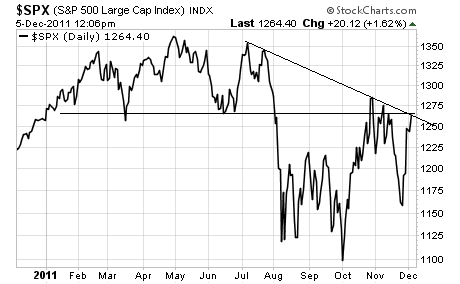
Truly, the only reason to buy into a stock rally here is based on the belief that the Fed or someone else is going to be providing more juice in the near future. The US economy has clearly begun to roll over in a big way: retail sales, GDP, and unemployment numbers are all being massaged heavily to make the situation look better than it is.
This is clear in corporate earnings which just posted their worst sequential drop since the first quarter of 2009: when the economy and markets were both falling off a cliff. These kinds of drops don't happen if everything's going well.
Across the pond, Europe's banking system is experiencing a solvency crisis on par with 2008. The markets believe that Germany and France will save the day by re-vamping the EU arrangement. However, this doesn't mean other EU members will agree to their suggestions (the idea of a German-lead EU is completely unpalatable to many EU states).
So I don't expect a viable solution to emerge in Europe this week. The math doesn't support any of the proposals EU leaders have come up with yet. And the fact it was the Fed, NOT the IMF or ECB or EFSF that stepped in to save the day last week should be a major red flag that Europe's out of ideas.
The markets seem to sense this as the Euro hasn't cleared resistance in any meaningful way yet. And unless we get above 135 and stay there, we're heading a LOT lower in the near future.
To conclude, in the short-term the markets are moving based on hope of more juice from the Powers That Be. However, the reality of the financial system today is downright frightening. The US economy is rolling over in a big way. Europe is imploding. China is heading straight into a hard landing. And on and on.
Heck, Europe alone could derail the entire financial system temporarily. The region's entire banking system is insolvent (with few exceptions). European non-financial corporations are running massive debt to equity ratios. And even EU sovereign states require intervention from the ECB just to meet current debt issuance, to say nothing of the huge amount of sovereign debt roll over that is due over the next 14 months.
The impact of this will be global in nature. The EU, taken as a whole, is:
1) The single largest economy in the world ($16.28 trillion)
2) Is China's largest trade partner
3) Accounts for 21% of US exports
4) Accounts for $121 billion worth of exports for South America
So if the EU banking system/ economy collapses, the global economy could enter a recession just based on that one issue alone (ignoring the other issues in China, Japan, and the US).
This is the reality of the financial system, no matter what the talking heads say. The IMF, Bank of England, and others have warned of a systemic collapse... do you think they're doing this for fun?
Many investors will have their portfolios wiped out in the coming carnage. It could be next week, or it could take place next year... but we ARE heading into a Crisis that will be worse than 2008.
Labels: collapse, Crash, Euro crisis, Euro default, europe
Thursday, December 01, 2011
What Does the Fed Know That We Don't?
The thought that should be on every investor's mind today is "Why did the Fed have to stage the coordinated intervention yesterday?'
Put another way, what exactly does the Fed know that we don't?
The whole thing smells fishy to me. Aside from the fact that the Fed clearly leaked its intentions as early as Monday night (hence the reason stocks rallied while credit markets weakened), there's something peculiar about the fact the Fed chose to do this at the end of November.
Why November 30? Why not today or Tuesday?
I think the answer is that the Fed stepped in to help its institutional investor/ hedge fund buddies. November was a horrible month for this crowd. And with Bank of America approaching $5 per share (a level which would require many institutions to liquidate due to regulations), the Fed was also helping out its favorite insolvent bank as well.
Aside from this, Europe was approaching the End Game. Germany won't permit the ECB to print nor to issue Euro-bonds. The EFSF plan was dead before arrival, failing to even stage a 3 billion Euro bond auction without having to step in and buy the bonds itself. And the IMF wasn't going to be an option either.
Put another way, ALL other bailout options had failed for Europe. The Fed was the lender/ intervener of last resort. That alone should have everyone worried as it indicates just how dire things had become in Europe.
However, there's something far more worrisome about the Fed's move which is that: IT SOLVES NOTHING.
Europe is facing a solvency crisis. Lowering the cost of borrowing Dollars does absolutely ZERO to help European banks raise capital. All it does is provide even more easy credit... which of course is the entire problem to begin with.
Banks across Europe are leveraged at an average of 26 to 1. This means that they own 2,600 times more assets (read: loans made to consumers, businesses, etc) than they do have equity.
At these leverage levels, if the assets fall even 4% in value, you've wiped out ALL equity, rendering the bank bankrupt!
In this situation, providing more liquidity to these banks helps in terms of short-term operations, but it does nothing to address the core issue which is too little capital and too much leverage.
So this move, as dramatic as it was for the stock market has done NOTHING to solve Europe's solvency crisis.
Indeed, we have reports that a large European bank was on the verge of collapse last night. Things are so bad that Germany has drawn up legislation to allow countries to leave the Euro while remaining in the EU.
I believe Germany itself will be using this option in the next few weeks as it realizes that it cannot and will not be able to prop up the Euro any longer (even Germany doesn't have the 1 TRILLION Euros' in capital that European banks need).
So do not be fooled. The Fed's move didn't fix anything. At most its bought the markets a few weeks' time before the whole mess comes crashing down.
So if you have not taken steps to prepare for this, the time to do so is now.
I can show you how.
Labels: Crash, crisis, Euro crisis, Euro default, liquidity, stocks
Tuesday, November 29, 2011
How the European End Game Will Play Out...
With the European End Game now in sight, the primary question that needs to be addressed is whether Europe will opt for a period of massive deflation, massive inflation, or deflation followed by inflation.
Indeed, with Europe's entire banking system insolvent (even German banks need to be recapitalized to the tune of over $171 billion) the outcome for Europe is only one of two options:
1) Massive debt restructuring
2) Monetization of everything/ hyperinflation
These are the realities facing Europe today (and eventually Japan and the US). Either way we are talking about the destruction of tens of trillions of Euros in wealth. The issue is which poison the European powers that be choose.
Personally, I believe we are going to see a combination of the two with deflation hitting all EU countries first and then serious inflation or hyperinflation hitting peripheral players and the PIIGS.
In terms of how we get there, I believe that in the next 14 months, the following will occur.
1) Germany and possibly France exit the Euro
2) ALL PIIGS defaulting on their debt
3) Potential hyperinflation in the PIIGS and peripheral EU countries
Regarding #1, we are already beginning to see hints of this development in the press:
DEATH OF THE EURO: SECRET PLOT TO WRECK THE CURRENCY
Ministers are understood to be deeply concerned that French President Nicolas Sarkozy and Germany's Chancellor Angela Merkel are secretly plotting to build a new, slimmed down Eurozone without Greece, Italy and other debt-ridden southern European nations.
Well-placed Brussels sources say Germany and France have already held private discussions on preparing for the disintegration of the Eurozone.
http://www.express.co.uk/
FRENCH AND GERMANS EXPLORE IDEA OF SMALLER EURO ZONE
German and French officials have discussed plans for a radical overhaul of the European Union that would involve setting up a more integrated and potentially smaller Euro zone, EU sources say.
"France and Germany have had intense consultations on this issue over the last months, at all levels," a senior EU official in Brussels told Reuters, speaking on condition of anonymity because of the sensitivity of the discussions.
"We need to move very cautiously, but the truth is that we need to establish exactly the list of those who don't want to be part of the club and those who simply cannot be part," the official said.
http://www.reuters.com/
With no one willing to foot the bill for the EFSF the markets are hoping Germany will step in and save the day. However, the German constitution forbids Germany from backing Euro-bonds.
German EconMin: court verdict rules out Euro bonds
German Economy Minister Philipp Roesler said on Thursday the constitutional court's ruling on Euro aid made it clear that joint Euro zone bonds were not an option.
Addressing left-wing opposition parties in the Bundestag lower house of parliament, Roesler said: "You continue to talk up Euro bonds although the constitutional court yesterday made it clear that as transfer union such as the one you propose on the left will never be possible, never be allowed."
"We don't want it politically, either, and we will not let the German taxpayer be obliged to pay for the debt of other countries," he said in a parliamentary budget debate.
http://www.reuters.com/
Moreover, Germans will simply not permit the monetization of debt. Weimar's hyperinflation happened in the early 1920s and is still fresh in the memories of the German people (those who lived through it undoubtedly told their children and grandchildren about it). So the German people will not tolerate price instability in any form.
Germany is not alone in having little or no desire to attempt to backstop the system. Indeed, NONE of the G20 countries wish to support the EFSF from a monetary standpoint (yet another sign that the bailout game is ending).
No new Euro zone money for debt crisis at G20
The Euro zone won verbal support but no new money at a G20 summit on Friday for its tortured efforts to overcome a sovereign debt crisis, while Italy was effectively placed under IMF supervision.
Leaders of the world's major economies, meeting on the French Riviera, told Europe to sort out its own problems and deferred until next year any move to provide more crisis-fighting resources to the International Monetary Fund.
"There are hardly any countries here which said they were ready to go along with the EFSF (Euro zone rescue fund)," German Chancellor Angela Merkel told a news conference.
http://www.reuters.com/
So... everyone claims they want to support the EFSF... but no one wants to commit the money. Moreover, Germany's constitution forbids the backing of Euro bonds... and the EFSF itself has failed to stage even a three billion Euro bond offering under normal market conditions.
Again, the bailout game is ending. Under these conditions, I believe Germany and France will push to either:
1) Leave the EU
2) Draft legislation that allows countries to leave the Euro but remain in the EU
3) Propose kicking out the PIIGS from the Euro
Whichever one of these options Germany opts for, the Euro will collapse. Indeed, the primary reason the Euro has been rallying since October is due to French banks and others selling assets (buying Euros) to recapitalize themselves.
Put another way, the Euro rally is in fact NOT a sign of currency strength. Instead, it is a sign that the major players are moving to cash (Euros) in an attempt to lower their exposure to PIIGS' debt.
Indeed, if we look at the bond or credit markets, it's clear we're into a Crisis far greater than 2008. Forget the stock market rally. Stocks ALWAYS get it last (just like in 2008). And before the smoke clears on this mess we're going to see sovereign defaults, bank holidays, riots, and more.
Many people will lose everything in this mess. Yes, everything. However, you don't have to be one of them. Indeed, I can show you how to turn this time of collapse into a time of profits.
Labels: chaos, crisis, Euro crisis, Euro default, stocks
Monday, November 28, 2011
Don't be fooled!
The markets are rallying hard today for three reasons:
1) Traders gaming the usual manic Monday
2) The markets were oversold having fallen six straight days
3) Short covering
These are the real reasons the market is exploding higher. Traders are simply using the (since refuted) IMF bailout of Italy rumor to gun the usual manic Monday rally and shred the shorts.
Technically, we were oversold and at support. So a bounce of some note here makes sense. However, a 3% rally? On rumors of an Italian bailout? Give me a break.
Regardless, this overnight move has already brought us up to resistance for the S&P 500. So we could easily see a reversal at any time.
The Euro also looks to be putting in a dead cat bounce:
I've received a few emails recently about my pessimism regarding the markets, even when stocks rally. The reason I am so pessimistic is because the bond markets, credit markets and interbank liquidity indicate that the situation in Europe is now into "2008 mode".
Indeed, Treasuries have already exceeded their 2008/2009 peak. Tell me, what do you make of a situation in which the bond markets (which are far larger than stocks) are acting as though we're in a Crisis worse than 2008... which stocks are rallying?
If you'll recall from 2008, stocks rallied and held up much, much longer than the bond or credit markets. For that reason stocks are a terrible indicator of the real state of the financial system... which is why I remain so deeply concerned about the markets even though stocks have staged several very sharp rallies.
The reality for Europe is very, very grim. Among other items, we've recently seen:
1) Italy's 10 year note pass 7% in yield (the end of the line level)
2) Germany post a failed bond auction
3) The EFSF plan scaled back with less leverage
4) German companies warning their Greek subsidiaries to prepare for contracts that are based in Drachma, NOT Euros
5) Germany hint that it will leave the Euro if the ECB prints money
6) The currency trading house ICAP prepare for the dissolution of the Euro
Do you still think stocks "get" what's happening today?
The reality is that we are already into a full-scale Crisis in Europe. Do you remember warnings of riots and systemic collapse in 2008? Well, we're getting those this time around. Do you think these folks are issuing these warnings because we're going to get through this mess easily?
Labels: economy, Euro crisis, Euro default, europe, stocks
Thursday, November 24, 2011
Six Plays On the European Banking Collapse
Europe is done. Finished.
The powers that be over there have completely lost control of
the markets. Germany just staged a horrific bond auction and
the ECB is intervening several times a day to stop Italy's bond
market (the world's 3rd largest) from imploding.
And that's just the tip of the iceberg.
The debt contagion has now spread to Spain, Italy, and even France.
It's quite possible France will lose its AAA rating in the near future.
We also have Germany threatening to leave the Euro outright if
the ECB prints money.
Which means... it's the End Game. No matter what, the defaults are
coming and the Euro will implode.
This is the reality for Europe. The whole system will be going down,
it's only a matter of time. And when it does collapse, it's going to
make Lehman Brothers look like a joke.
I know the markets have yet to fully realize this... but it took them a while
to realize 2008 as well. And when they did, things moved VERY quickly.
So if you have not already taken steps to prepare for systemic failure,
you NEED to do so NOW. We're literally at most a few months, and
very likely just a few weeks from Europe's banks imploding.
Take steps to prepare our loved ones and personal
finances for systemic risk:
You need to know:
1) how to prepare for bank holidays
2) which banks to avoid
3) how much bullion to own
4) how much cash is needed to get through systemic crises
5) how much food to stockpile, what kind to get, and where to get it
ask me at: generalfoundation@safe-mail.net
Labels: Crash, crisis, Euro crisis, Euro default, risk
Monday, November 21, 2011
Default and Failure, Euro OUT
Stocks broke down in a big way last week as the situation in Europe has become truly dire. I'll be addressing that situation in greater detail soon, but for now, you should know that there are truly only two possible outcomes for the Euro:
1) The ECB prints money and Germany leaves the EU
2) Germany remains in the EU but moves to kick other countries out as the defaults start coming fast
POINT
The market has already proven that the EFSF won't save the Euro. And Italy, the third largest bond market in the world, is creeping towards a default by the minute. So the above outcomes are the only realistic options that are left. And both of them will send the Euro, and stocks, lower in a big way.
On that note, the S&P 500 broke down last week as the descending trendline (black line) from the July top proved to be too much for this latest rally to overcome. We've now taken out the lower trendline (green line) that supported stocks since October as well as critical support (red line) formed by the trading range that dominated the market's action from August through October.
Once we get a definitive move below the red line in the chart above, then the door is open for us to test support at 1,175 and possibly even 1,125 in short order.
This is a holiday week so trading volume will be light. However, recall that it was during Thanksgiving 2009 that the sovereign defaults first started when Dubai asked for an extension on $60 billion in debt. Will we get a European version of the Thanksgiving day collapse this time around with Italy? It's definitely possible as the ECB is now intervening on a daily basis to slow down the bond implosion over there.
On that note, both Gold and Silver are looking deflationary... or at least undergoing liquidations.
Remember, defaults are deflationary in nature, and given that Europe is literally on the brink of systemic failure, Gold and Silver's recent action may be hinting that we're about to see another round of defaults/ deflation in the markets.
After all, when you combine the situation in Europe, along with the ongoing Depression in the US, MF Global's bankruptcy, and the fact that most institutional investors remain heavily invested to the long-side (opening the door for intense selling pressure as everyone has gone "all in"), you've got a recipe for a REAL collapse.
So, just be aware that if things get messy, the markets could get downright UGLY fast. Leverage levels today exceed those of the Tech bubble. And we've already had one player taken out by bad bets (MF Global).
Labels: chaos, Crash, Euro crisis, Euro default
Monday, November 14, 2011
The EURO is finished
There are two primary stories for the markets today. They are:
1) The political/ financial reality facing Europe
2) The US stock market rally
Regarding #1, it is clear as day that the EU in its current form is finished. I've been saying this for months, but now even the mainstream media is picking up on rumblings that Germany wants to exit the Euro or at least restructure the entire EU.
DEATH OF THE EURO: SECRET PLOT TO WRECK THE CURRENCY
Ministers are understood to be deeply concerned that French President Nicolas Sarkozy and Germany's Chancellor Angela Merkel are secretly plotting to build a new, slimmed down eurozone without Greece, Italy and other debt-ridden southern European nations.
Well-placed Brussels sources say Germany and France have already held private discussions on preparing for the disintegration of the eurozone.
http://www.express.co.uk/
FRENCH AND GERMANS EXPLORE IDEA OF SMALLER EURO ZONE
German and French officials have discussed plans for a radical overhaul of the European Union that would involve setting up a more integrated and potentially smaller euro zone, EU sources say.
"France and Germany have had intense consultations on this issue over the last months, at all levels," a senior EU official in Brussels told Reuters, speaking on condition of anonymity because of the sensitivity of the discussions.
"We need to move very cautiously, but the truth is that we need to establish exactly the list of those who don't want to be part of the club and those who simply cannot be part," the official said.
http://www.reuters.com/
The reality of the Eurozone is as follows:
- Germany cannot and will not permit debt monetization to take place and so will back out of the Euro rather than foot the bill for other countries. With Weimar still present in the public's conscious, the German populace simply will not stand for inflation of any kind.
- The leveraged EFSF has already failed. It's already failed to auction even 3 billion Euros' worth of bonds... and it's supposed to raise over 1 trillion!?! Add to this the fact that no G20 countries want to support it and the EFSF is FINISHED.
- Greek will default again. Italy will default. Spain and the other PIIGS will default. The Euro will collapse.
These are the facts. Everything else (political elections, austerity measures, etc) is just a distraction. The whole mess is just like 2008 when the plain simple truth was in front of all of us though 99% of the pundits focused on the various distractions (Wall Street CEOs saying the worst was over, Hank Paulson's Bazooka, etc).
And Europe can, at best, hope to replicate what happened to the US in 2008. It's entire banking system is too leveraged. And now we're talking about entire countries going bankrupt.
Now for the other story in the markets today: the stock market rally which is based on fantasy and dreams.
I've heard every excuse for this move ranging from "QE 3 is just around the corner" to "the leveraged EFSF will work," but I've yet to hear anything fact-based that justifies this move as being something more than short covering and the usual bear market rally.
Let's take a look over what's happened since the market bottomed in early October:
1) Greece defaulted
2) Italian bonds imploded
3) The EFSF failed to raise even 3 billion Euros
4) French/German bond spreads hit all time highs
5) The Fed re-opened swap lines to Europe AND the Bank of Japan
And stocks have rallied 14% on these developments?
Do people forget that during the 2008 debacle the market rallied 11%, 17%, even 20%?
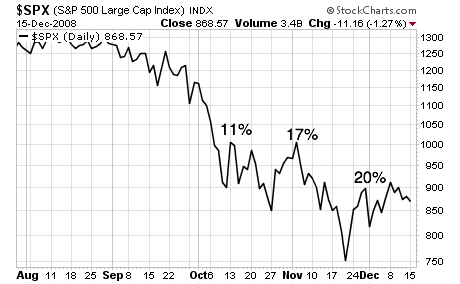
Having said all of that, stocks look to have formed a triangle pattern, which presents the possibility of a final thrust up, possibly to 1,300 on the S&P 500.
This move will likely be followed by a very sharp sell-off. With stocks tracking the Euro, it's worth noting that a head and shoulders pattern is forming in European currency.
Folks, here's the deal: the EU is out of options and out of time. Yes, we've seen some symbolic shifts in the political landscape, but the reality is:
1) The EFSF CANNOT raise the funds it needs to bail out Europe
2) Germany WILL NOT monetize the PIIGS' debt
3) Greece will stage an even greater default, as will the other PIIGS nations
The powers that be know it. Why do you think China is importing a record amount of Gold... because they believe in the Euro? Weren't they the ones who were supposed to save Europe?
The reality is that the powers that be (the Federal Reserve and ECB) are fast losing control of the system. Bernanke's already admitted he hasn't got a clue how to solve the financial system's problems. The Bank of England says we're facing the greatest financial crisis in history. Even the IMF has warned that we're heading towards a global financial meltdown.
Folks... these organizations don't issue warnings like this just for fun. They're the ones who are SUPPOSED to SAVE the system. Do you think they're issuing these warnings because everything is fine?
So ignore stocks. I know, I know, they've made a huge move to the upside. But that huge move was just 14%... and we had rallies of 17% and 20% in 2008. How did those work out? Were they a good time to buy stocks?
Again, the EU will be broken up in the coming weeks. When it is, this market rally will collapse. And the ensuing carnage will make 2008 look like a joke.
So if you've not already taken steps for what's coming, the time to do so is NOW before the real mess begins.
Labels: chaos, Euro crisis, Euro default
Thursday, November 10, 2011
The Third Largest Bond Market in the World is Imploding
I have been warning for days that stocks are the last to "get it" and that this latest rally should not be trusted.
Well, by the look of things, stocks are finally waking up to what the credit and bond markets have been telling us for weeks: That the European debt-implosion has now shifted from a relatively small problem (Greece) to a MAJOR problem (Italy).
Remember, worldwide exposure to Greece is roughly $280 billion. Worldwide exposure to Italy is more than THREE TIMES this. Italy is the third largest bond market in the world (behind Japan and the US). So when it implodes, the whole financial system shakes.
Well, according to Barclay's Italy has now gone "mathematically beyond the point of no return."
Italy is the REAL systemic risk today. The Italian ten-year note just cleared 7.2% earlier this week. Once it clears 8% it's GAME OVER for Italy. And the EURO will go down.
Labels: Euro crisis, Euro default, Italy